

His beard: an avalanche of honey
an avalanche
of thorns. In a bar too close to the Pacific,
he said, “I don’t love you,
but not because I
couldn’t be attracted to you.” Liar—
even my soul
is potbellied. Thinness,
in my mind, equals the gay men
on the nightly news.
Kissed by death & public scorn.
The anchorman declaring,
“Weight loss is one
of the first symptoms.” The Portuguese
have a word for imaginary, never-
to-be-experienced love.
Whoop-de-doo.
“I don’t love you,” he said.
The words flung him back—
in his eyes, I saw it—
to another bar
where a woman sidestepped his desire.
Another hunger.
Our friendship.
In tenth grade, weeks after
my first kiss, my mother
said, “You’re looking thinner.”
That evening, I smuggled a cake
into my room.
I ate it with my hands,
licked buttercream off
my thumbs until I puked.
Desire with no future,
bitter longing—
I starve myself by yearning
for intimacy that doesn’t
& won’t exist.
Holding hands on a ferry. Tracing,
with the tip of my tongue,
a jawline. In a bar too close
to the Pacific, he said,
“I don’t love you, but not
because I couldn’t be attracted to you.”
His beard:
an avalanche of thorns,
an avalanche of honey.
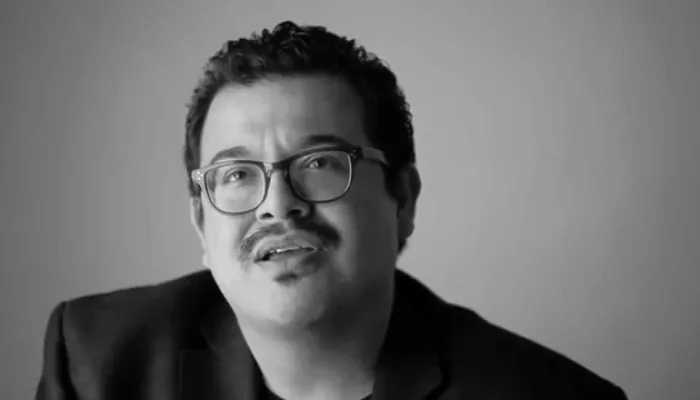
A poem that explores private desire and longing, and the pain of homophobia.
-
The lines and stanzas found in Corral’s poem sprawl across the page, and he employs spaces with quite intentionality. As you read the poem aloud, notice what happens when you transition from line to line and stanza to stanza. Are you rushing through the spaces? Gliding through them? Pausing? Can you be intentional about how you approach the poem’s spaces?
-
What sort of desire do you think the poet is referring to in the following lines? What does “desire with no future” conjure up for you?
Desire with no future,
bitter longing—
I starve myself by yearning
for intimacy that doesn’t
& won’t exist.
-
What feelings are you left with when you read the lines below? Some of them might feel contradictory, like feeling tired but satisfied. What complexity of emotions is expressed by these final verses and the images they contain?
Desire with no future,
bitter longing—
I starve myself by yearning
for intimacy that doesn’t
& won’t exist.
Holding hands on a ferry. Tracing,
with the tip of my tongue,
a jawline. In a bar too close
to the Pacific, he said,
I don’t love you, but not
because I couldn’t be attracted to you.”
His beard:
an avalanche of thorns,
an avalanche of honey.
-
Corral’s poem doesn’t follow a linear timeline. Instead, he explores different moments in the speaker’s life, travelling back and forth the present and past. Notice and track where the various events in the poem are taking place. Do you get a sense that the speaker’s feelings change across time? Do some feelings remain constant?
-
In the poem, Corral addresses homophobia, both internalized homophobia and the hate the speaker encounters as he moves through the world as a gay man. Where in the poem does Corral show us this homophobia? How do you feel as you read these parts? What connections can you make to things you may have experienced in your own life?
Writing activity: Notice how in the middle of the poem, Corral cuts the intensity of the piece by writing "Whoop-de-doo." Reflect on the purpose of this word and the feeling it leaves the reader. Write a poem that starts with or incorporates the word Whoop-de-doo or a word from this list:
big whoopwhatever
hoopla
fancy shmancy
Useful Links
Eduardo C. Corral reading: https://youtu.be/L2ZfnG-TXB8?si=KSmHFFmSc_xySnp5
Conversation with Eduardo C. Corral: https://artsci.washu.edu/ampersand/listening-language-conversation-eduardo-c-corral
Eduardo C. Corral, "Autobiography of My Hungers," from Guillotine. Graywolf Press, 2020. Published with permission from Graywolf Press.