
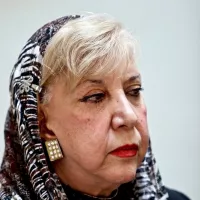
(To the lady of Persian storytelling, Simin Daneshvar)
My country, I will build you again,
if need be, with bricks made from my life.
I will build columns to support your roof,
if need be, with my bones.
I will inhale again the perfume of flowers
favored by your youth.
I will wash again the blood off your body
with torrents of my tears.
Once more, the darkness will leave this house.
I will paint my poems blue with the color of our sky.
The resurrector of “old bones” will grant me in his bounty
a mountain’s splendor in his testing grounds.
Old I may be, but given the chance, I will learn.
I will begin a second youth alongside my progeny.
I will recite the Hadith of “love and country”
with such fervor as to make each word bear life.
There still burns a fire in my breast
to keep undiminished the warmth of kinship
I feel for my people.
Once more you will grant me strength,
though my poems have settled in blood.
Once more I will build you with my life,
though it be beyond my means.
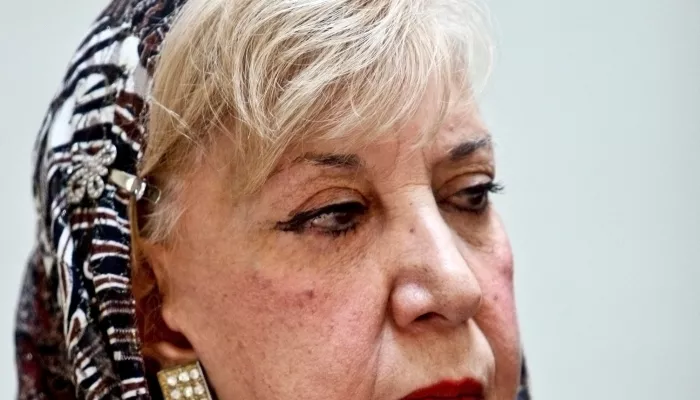
A patriot vows to rebuild her homeland.
- What is the best tone, pitch, speed, and volume (loud or quiet) to deliver this poem effectively on stage? Why?
- Who is the speaker in this poem? Describe them in as much detail as possible. Is the speaker in this poem similar to the poet or someone very different from her?
- What is the dominant mood in this poem? Have you ever felt the same way about your country of origin or the country where you live? Why?
- Based on the information available to you in the poem, can you infer or guess the circumstances under which this poem was written? Use your imagination to invent a possible backstory.
- Simin Behbahani was an Iranian poet. This is the story behind the poem in her own words. The text, like the text of the poem, is a translation.
“This poem was written on March 11, 1982, and dedicated to novelist Simin Daneshvar.
“Those were the bad years, the years of executions on rooftops, the years of unjust trials in the name of Islamic justice. I was dismayed with all that destruction around me, alone at home in my kitchen at a small table with pen and paper in hand and a thousand sorrows in my heart. I sat down. Poetry was surging in my soul. Witnessing all that devastation, I asked myself, what can be done? Our homeland was in ruins.
“I got up and poured a cup of tea, thinking about trampled dreams. I had no one to talk to. A few nights earlier I had visited Simin Danshvar who was even more devastated and unanchored than I was. She hadn’t yet written The Unanchored Island (جزیره ی سرگردانی ). When she spoke, it was as if she screamed from the bottom of my own heart.
“Suddenly, this poem arrived. A poem that hints at the hope for future. My heart grew light. I thought to myself that even if I die, I will rise again to defy the death-dealing Ahriman.* I wrote, “My country, I will build you again.” I asked my heart, “With what?” and my heart responded, “if need be, with my bones . . .” And the poem took shape. The same poem you are reading now. I dedicated the poem to Simin Danshvar whose heart, like mine, beats in the hopes of rebuilding our homeland.”**
Was this close to the story you told yourself about the poem? In what ways was it similar or different?
* Demon, God’s adversary in Zoroastrian religion
**Simin Behbahani’s account of the origin of this poem can be found in this link. The translation into English is by Bänoo Zan.
- Barack Obama, the forty-fourth President of the United States, quoted this poem in his 2011 Nowruz message. Watch the video here: https://www.youtube.com/watch?v=OfZfnRu4X0k
To the best of your knowledge, how has the situation in Iran changed since the year the poem was written (1982) or the year President Obama made that speech (2011)? For an update, check the first article under “useful links.” Is the poem still relevant? Is the poem relevant to non-Iranians? Why or why not?
Writing activity: Apostrophe is a figure of speech in which a thing, a place, an abstract quality, an idea, a dead or absent person, is addressed as if present and capable of understanding. For example, in this poem, the speaker addresses her country.
Write a poem using apostrophe. In your poem address the country of your origin, or the country where you live.
Useful Links
- Iran: Civilians trapped between extreme State repression and violations arising from devastating conflict with US, Israel, UN Fact-Finding Mission finds
- Encyclopaedia Iranica: Simin Behbahani
- The Roar of the Lioness
- Simin Behbahani reciting this poem in Persian
- Pop Singer Dariush Singing the poem
- Classical Persian singer Vahid Taj singing this poem
Translated by Farzaneh Milani and Kaveh Safa. From A Cup of Sin: Selected Poems. Published 1999 by Syracuse University Press.