
When the burning started in August, because it kept
its own schedule, it could be early without seeming eager.
On Point Reyes there was fire locking antlers with fire
and the fires at Big Sur had so broad a wingspan
they could soar for miles without flapping.
Inland, by Fresno, a fire slunk through pine wood,
shoulders bobbing piston-like above its back.
Antonio said it might last through December.
I said I wouldn't be survived, I mean, surprised by it.
In the foothills of the Sierra, long since blasted
by water from flumes to slurry into sluices,
the fires were simplifying nature down to granite.
The images showed black stumps of chalk fragility,
irrelevant stalks, and coincidental skeletons.
There was a bear skull somewhere, and the thing
about bear skulls is just how narrow they are.
What's missing is muscle, and there's so much
missing, you find it hard to comprehend the force
of that jaw. There's a kind of religion in thinking
about things that have gone away. Take the sun,
for example, stashed away in smoke, its grey
glow cratering the high-noon ambiguities, or else
on that fluorescent Wednesday, a broken yolk
and oozing orange runnily. Temperatures overnight
hit rock bottom and stuck the landing. The fires
kept shovelling scenery into their bellies. I was
reading the poems in which love is a horseman,
spurring with fire and bridling with ice. California
was burning. I was glad I packed sweaters.
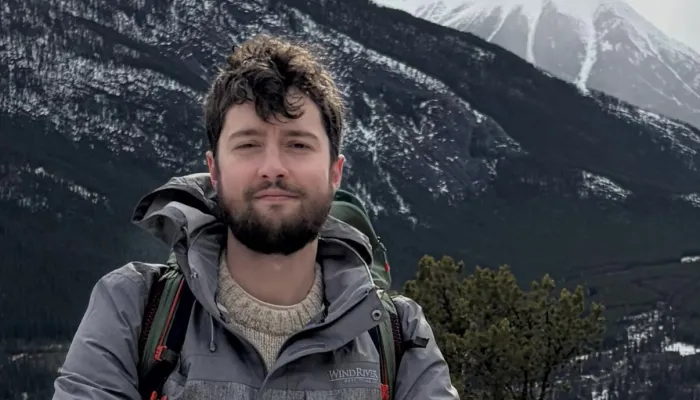
A wildfire is personified as a ravenous, insatiable creature. Joseph Kidney contemplates loss and the act of continued living alongside an unfolding disaster.
-
Try reading this poem aloud as you would a story or a letter rather than a poem. Who could the speaker be addressing?
-
What is the tone of this poem? Where do you find clues to this tone?
-
The speaker states, “There is a kind of religion in thinking / about things that have gone away.” Find examples of absence, or things that have “gone away,” in the poem.
-
Wildfires are personified in this poem. How would you describe their character?
-
The final three lines bring in imagery around horseback riding. Look up the terms “spurring” and “brindling” within the context of horseback riding and consider how they relate to the speaker’s reaction to the wildfires.
-
Explore the contrast between the speaker’s tone and the content of the poem (what the poem is about). Is the tone surprising, given the content of the poem? Why or why not? What is the effect of this tension on the reader?
-
The title of the poem, “A Net I Seek to Hold the Wind” is a borrowed line from the famous Tudor sonnet by Sir Thomas Wyatt called, “Whoso List to Hunt, I Know where is an Hind.” Wyatt uses the metaphor of a deer hunt to describe the futile pursuit of a woman who does not want to be touched. The phrase is also an adynaton: a figure of speech that uses hyperbole (exaggeration) to describe an impossible task. A net by its very nature cannot catch the wind. How does this title contextualize your reading of the poem?
Writing activities:
This poem is set up as a reflection on a time in the speaker’s life when there was an ongoing ecological disaster, that includes both personal details and observations. It is written as though it is being recounted to a friend. In the spirit of this poem, write about a time in your life when you were aware of an unfolding disaster as though you are explaining it to a friend. Include some details about what you were up to, personally, at the time.
Write a poem in which an unfolding disaster, ecological or otherwise, is personified. Consider how you would characterize your chosen disaster.
Useful Links
Joseph Kidney is a Canadian poet working at Stanford University in California. This resource is an interactive map that allows you to track active wildfires in Canada and the United States. Fire Information Resource Management US/Canada: https://firms.modaps.eosdis.nasa.gov/usfs/map/#d:24hrs;@-100.0,40.0,4.0z
Here is a link to the poem, “Whoso List to Hunt, I Know where is an Hind”, By Sir Thomas Wyatt: https://www.poetryfoundation.org/poems/45593/whoso-list-to-hunt-i-know-where-is-an-hind
Here is a review of Devotional Forensics, Kidney’s collection that includes, “A Net I seek to Hold the Wind”: https://miramichireader.ca/2025/03/devotional-forensics-by-joseph-kidney/
Here is an interview between Joseph Kidney and Griffin Poetry Prize Trustee and fellow poet Karen Solie: https://www.youtube.com/watch?v=1BwonJTbAxA
Joseph Kidney, "A Net I Seek to Hold the Wind," from Devotional Forensics. Goose Lane Editions, 2025. Griffin Poetry Prize 2026 Canadian First Book Prize Winner. Used with permission from The Griffin Trust For Excellence In Poetry. For more information, please visit www.gooselane.com.