
Smoke and ash of November.
A landscape of sediment and char,
lead and gold leaf, mutilated sod
racing on its planetary camber.
On a kitchen table's crude altar
a bowl of radishes is offered
with a dish of salt for dipping whole.
That's how my father would eat them.
My mother sliced them thin.
Theirs was no house in a fairy tale.
Yet the knife that trimmed the stem
and scraped the blemished skin
would halt at her intrepid thumb.
Radishes of rosy cheeks, of snow,
peppery radishes of yesteryear,
which made my tongue go numb,
why are you so much milder now?
You don't set my mouth on fire.
Did something in your cultivation change,
or does sensation wane with age?
In a French film, I saw two friends
spread butter on radish halves; strange,
I thought, but now it's all the rage
to sauté them. Their trailing ends
clog my drain stopper. Best is raw:
it's "war" backward, like a spell
grown in the cold ground, color
of rose and snow—good to gnaw
a vegetable so filial and feral
late in the year, when the knife is duller.

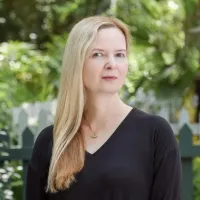
Ange Mlinko’s consideration of the radish introduces a constellation of characters and feelings, inviting reflection on nostalgia and the passing of time.
- Ange Mlinko’s poem “Radishes” is written in sestets, meaning stanzas of six lines each. These sestets also follow a rhyme scheme, ABCABC. When you read this poem aloud, are there any places where this rhyme scheme seems to break? How does it feel when you come upon these lines in your recitation?
- While the poem uses the same rhyme scheme throughout, this rhyme scheme is not totally consistent. There is at least one true break in the pattern, and not all Mlinko’s rhymes are what we’d call “perfect rhymes,” meaning the paired rhyming words don’t share the exact same vowel sounds. In one stanza, for example, Mlinko uses an “eye rhyme,” where the two rhyming words are spelled similarly but aren’t pronounced the same. Can you identify this eye rhyme? What effect does this eye rhyme have on your reading? Is it as noticeable when you read the poem silently to yourself as when you read it aloud?
- What is the speaker’s tone in this poem? How do you think she feels about the poem’s subject matter?
- Of her parents, the speaker says, “Theirs was no house in a fairy tale.” What does this line tell us about the speaker’s childhood home?
- Towards the end of “Radishes,” the speaker asks a couple questions: “why are you so much milder now?” and “does sensation wane with age?” In what ways is this a poem about growing up?
Writing activity: Write a poem about a vegetable or fruit you like, or one that has some other significance in your life (perhaps you really hate it!). As a nod to Ange Mlinko, write your poem in sestets.
Useful Link
Listen to Ange Mlinko in conversation with fellow poet Sarah Howe: https://www.youtube.com/watch?v=bFKjasbD9Eo
Ange Mlinko, "Radishes," from Foxglovewise. Faber & Faber, 2025. Griffin Poetry Prize 2026 Finalist. Used with permission from The Griffin Trust For Excellence In Poetry.